
World Traveler Magazine Inaugural Issue | July 2026
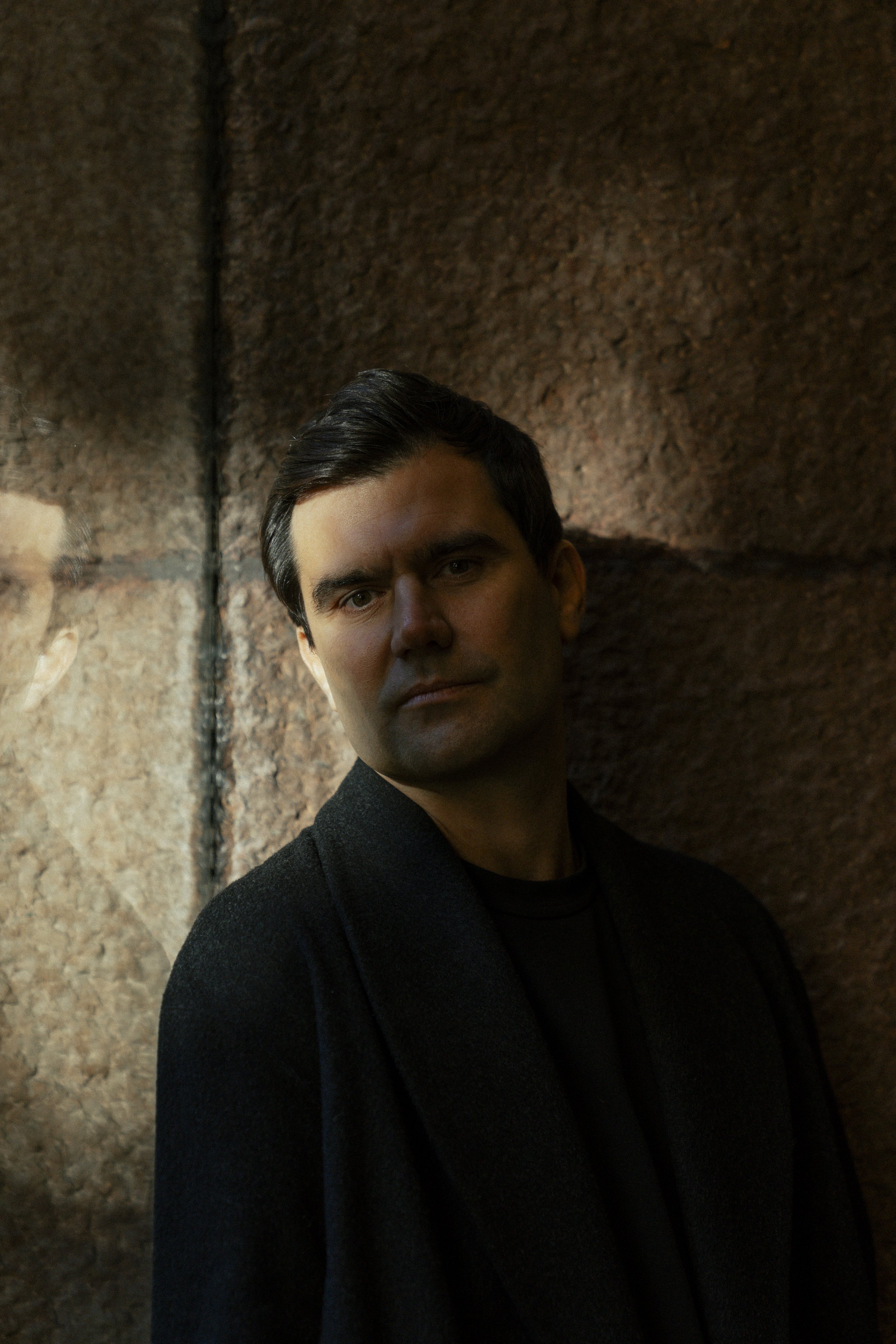
Portrait: Jasmine Deporta
Architecture / Milan
Peter Pichler: The Architecture of Stillness
From mirrored houses in an apple orchard to Alpine hospitality concepts shaped by silence and simplicity, Peter Pichler designs architecture that slows the body, quiets the mind, and listens closely to place.
Architecture that disappears. That mirrors the world around it but leaves no trace. In Bolzano, beneath the quiet shadows of the Alps, a pair of mirrored houses vanish into the apple orchard around them. They echo everything: trees, sky, silence, yet assert nothing. That paradox is the essence of Peter Pichler’s architecture. “Good architecture is emotions,” he says. “It should give back something to us humans.” Whether designing a sculptural hut in South Tyrol, a suite that nearly disappears, or a hospitality concept for the Venice Biennale, the Milan-based architect seeks to evoke feeling through simplicity, sensitivity to place, and refined restraint.
Lineage
Raised in Italy’s northernmost region, Pichler grew up speaking both German and Italian. His architectural roots were shaped in part by his father’s cousin, the revered artist Walter Pichler, whose collaborations with Coop Himmelb(l)au and Joseph Beuys left a lasting impression. “Walter was always a great influence on me, a great inspiration. He told me all the stories from the 60s, 70s, and all these radical projects they did during that time.” Walter encouraged him to apply to the University of Applied Arts in Vienna, where Peter studied in Zaha Hadid’s master class. He completed his diploma under her guidance. He then worked for OMA and Rem Koolhaas in Rotterdam before returning to Hadid’s offices in London and Hamburg. In 2015, he co-founded Peter Pichler Architecture in Milan with his partner, Silvana Ordinas, establishing a practice rooted in contextual research, human connection, and distinct formal language.
Vernacular Lessons
Despite a foundation in conceptual, avant-garde architecture, Pichler grounds his practice in approaches that are contextually attuned and deliberately elemental. Among his most enduring influences is Bernard Rudofsky’s 1964 MoMA exhibition Architecture Without Architects, which celebrated vernacular structures shaped not by formal design but by necessity, geography, and material availability.
Rudofsky’s work illuminated an era when architecture was not a specialized profession, but an instinctive act of building. “He basically analysed the profession of an architect, but hundreds and hundreds of years ago, where there was not really the name, it was not the architect, but it was the people that built with the things they had there,” Pichler explains. What emerged, he adds, was “a very geographically related architecture… never built for a certain style, but… for a certain logic and a certain need.” These principles continue to guide his own work today.
Pichler often references such vernacular wisdom, designing in response to climate, terrain, and tradition. “The houses in Greece are white,” he says, “not because they look cooler, but because they are cooler because of the colours.” Simplicity, in his view, is not reductive. It is practical. “You just solve certain problems in a very simple way.”
Enduring Forms
Timelessness, not trend, is at the core of Pichler’s design philosophy. He believes that beauty and longevity go hand in hand and considers enduring structures, like the Duomo in Milan, to be the true benchmark of sustainability. “People will use the Duomo, and it’s so beautiful that you will never tear it down,” he notes, referencing the iconic cathedral’s enduring resonance after more than six centuries of construction and reverence.
One of the earliest markers of that sensibility was Pichler’s Delirious Overhaul, a competition-winning mountain hut proposal together with arch. Pavol Mikolajcak. Though it preceded the formal founding of his studio, it gave him a sense of clarity that still resonates. “You still feel it,” he says. “You would do the same today…in terms of materials, in terms of design.” The sculptural concept reimagined a traditional Alpine shelter with contemporary form, merging functionality and topographic sensitivity. Though never built, it affirmed Pichler’s ability to balance bold expression with contextual subtlety, an early articulation of the voice he continues to refine.
Another expression of this enduring philosophy is the Hotel Schgaguler in Castelrotto, Italy. One of the studio’s first hospitality commissions, it involved a radical transformation of a dated 1980s hotel into a minimalist retreat inspired by the Dolomites. Clad in a crisp white façade, the restructured volumes echo the silhouettes of mountain peaks. Inside, the materials, local chestnut wood, natural stone, and plaster, create a serene, tactile environment that seamlessly connects interior and exterior. “You see when you go there now, it still works,” he says. For Pichler, that is the essence of sustainability, not just material efficiency, but aesthetic and functional longevity. “It comes back to this sustainability thing,” he adds, noting that well-designed buildings should not need to be torn apart or updated every few decades simply because they have gone out of style.
Projects in Stillness
A quiet visual sequence of mirrored surfaces, Alpine retreats, material restraint, and architecture in dialogue with landscape.
Swipe or scroll horizontally to view the gallery.
Site & Soul
Timelessness does not emerge from abstraction. It begins on the ground, with earth and human need. Every project at Pichler’s studio begins with an in-depth understanding of the site. “We don’t design a project if we don’t see the site first of all,” he says. “You have to understand it, be there, research about the site.” But just as essential as the land is the person or community who will inhabit the space. “Everybody lives differently, everybody has a different expectation, different culture,” he says. “We need to understand you.” He elaborates that his studio has worked in locations as distinct as Abu Dhabi and Italy, each requiring a different architectural response, each is “a different story.”
Mirror Houses
This fusion of landscape and lived experience comes to life in one of his projects: the Mirror Houses in Bolzano. The client wanted to add two small rental units to her property on the condition that they remain entirely out of sight from her garden. The site, beside her farmhouse and pool, was limited in size, and she emphasized she did not want to see the new structures from her garden. Pichler responded with a design that disappeared into the scenery, using a mirrored glass facade facing the garden to reflect the landscape and make the volumes recede visually. The other facade, facing east, opens to the apple orchards and landscape, allowing for light-filled interiors and privacy. From the garden, the buildings resemble abstract sculptures; from within, they frame serene views of apple trees and light. Inside, dappled sunlight filters through apple branches, casting shifting patterns on the walls. Though modest in scale, the project became a breakthrough, helping to define his voice as a young architect. Its simplicity and restraint continue to resonate, more than a decade later.
Slowness
Pichler believes the power of architecture is not always immediate. A well-designed space, he suggests, can continue to reveal subtle qualities over time, details that are not noticed at first glance but gradually deepen the experience. This quality is particularly important in his hospitality work, which emphasizes serenity and slowing down. His studio has developed hospitality concepts rooted in what he calls “slow-down tourism,” where architecture offers not stimulation, but stillness. “It is not about more saunas and five pools,” he says. “It is about simplicity.”
For Pichler, luxury in architecture has little to do with opulence. “It’s not about expensive materials or a five-star hotel,” he explains. “Sometimes, the smaller the budget, the more interesting the solution.” True luxury, he says, is found in time, tranquility, and connection, with oneself and with nature. “You enter a certain space, and it starts to slow you down. You breathe, you disconnect, you find yourself.” That, to him, is architecture’s quiet power.
One such project, presented at the Venice Biennale, was a hospitality concept for YOUNA Nature Resorts. It combined treehouse-like structures immersed in nature with a hybrid mountain hut that could serve both hotel guests and the public. Though the project has faced delays, Pichler notes that many architectural ideas return over time, sometimes in new form or context.
The Role of Technology
While his designs are firmly grounded in tradition and emotion, Pichler is not blind to technology’s role in the profession. AI is already used in his studio for visualizations and animations, but not for core design. “You still need to have the decision,” he says. “AI is not choosing for you.” Yet he worries about what may be lost. “I want to have a coffee with you. I want to go for lunch with you. I want to discuss with you this design.” He recalls how a friend’s production company was shuttered after clients began relying on AI-generated imagery. “Now you do it in an afternoon,” he says. “It’s eliminating a lot of jobs.”
Process & People
Design, for Pichler, is a conversation. “Maybe it is our interpretation of the story… of the site, of the client,” he says. “But it is influenced by that,” by the specific context and people involved. His Milan studio reflects that collaborative ethos. With around fifteen team members from countries including Italy, Austria, Denmark, Spain, Iran, and Turkey, the team is intentionally international. “There is no strict hierarchy,” he says. “Everybody should feel involved in the process.”
This horizontal structure is matched by an equally intentional work culture, one that avoids the long hours typical of large firms. Pichler prioritizes results over time spent. If the job is done, “go ski on a Monday,” he says. “Even better, go out to sea for the weekend and come back fresh on Monday.” The goal is not relentless output, but meaningful, well-resolved work.
Sketches in Transit
Travel continues to shape his practice. Whether for site visits or lectures, he sees travel as a means of absorbing not just landscapes but atmospheres. He always carries a small analog notebook for quick sketches or early ideas. “Sometimes when you go there and something comes in your mind,” he says, “it is just notes.” Even simple thoughts in motion may return as the seed of a future project.
Recent travels have taken him to Montenegro for an architectural lecture, where the striking natural beauty left a lasting impression. “When you land there, it’s impressive,” he says. One place still on his list is Brazil, long a destination he hopes to explore more deeply, not only for its architectural richness but for the immersive experience it promises.
Unbuilt Futures
Some ideas take years to find the right form. An unrealized hospitality project first shown at the Venice Biennale featured clustered units and a hybrid mountain hut. It has not been built, but Pichler has not shelved the concept either. “Sometimes you design something, and the client returns years later,” he notes.
That patience paid off in South Tyrol, where, after SANAA was awarded a competition for a new mountain station on one side of the mountain, Pichler’s studio was later commissioned to design a hospitality concept on the opposite slope. The projects are distinct yet share a spirit of elevated, elemental experience in the Alpine landscape.
Still, not every project finds its moment. “That’s why architects are always dressed in black,” he jokes. “You know why? Because they need to bring their projects to the funeral.” The line comes from one of his professors, delivered with a wry smile. But even unbuilt, ideas carry weight. In their failure or delay, they still shape a future that architecture patiently awaits.
Legacy
Not all stories are realized, but the ones that are may still speak across generations. When asked what he hopes people might feel in his buildings a hundred years from now, Pichler pauses. If a space can still move someone, create a breath, a stillness, a moment of connection, then that, for him, is architecture that endures.
Beneath that vision lies a deeper conviction: that progress is not a break from history, but an extension of it. “Looking back to the past,” he says, “another way of anticipating the future.” It’s a philosophy that runs quietly through all his work, anchoring form in memory, inviting emotion through stillness, and shaping what’s to come by listening, first, to what has already been.
Architecture that endures does not announce itself. It listens, recedes, and leaves room for the human experience to arrive.