
The Quiet Revolutionaries of Sharon Springs
From Mount Vernon to the Sir John Soane Museum, Adelphi Paper Hangings has revived a nearly vanished American craft, restoring historic interiors one block, one color, and one impression at a time.
Listen to the article
Full narration Add final running time
Beneath layers of paint, paper, plaster, and time, rooms remember.
The roll of paper coming off the bench is six feet of repeat, a French design from 1799 that was almost certainly never hung in anyone’s parlor. The original, somewhere in an archive, sat untouched for two centuries before it surfaced. Now it stretches across a long table in a clapboard building in Sharon Springs, New York, where a woman presses a Swiss pear-wood block, laminated and layered the way a violin is layered, down into a thin film of paint the color of clay and cinnabar. She lifts. The pattern is there. Five colors will land before the day is out, each from its own block, each block aligned to the last by the tiny marks left by brass registration pins.
This is Adelphi Paper Hangings, a name known intimately within a rarefied circle, yet almost invisible outside it. Among curators at Mount Vernon, conservators at the Sir John Soane Museum in London, designers at the Cooper Hewitt in New York, and owners of historic houses who care deeply about what should hang in a Federal dining room, Adelphi is the answer to a question that, for much of the twentieth century, did not have one. Where do you get historically accurate, hand-block-printed wallpaper of the kind Americans were ordering from Paris in the years between the Revolution and the Civil War? You couldn’t, really. Then, in 1999, two men in upstate New York decided to figure it out.
To understand Adelphi is to understand that wallpaper, at its highest level, is not surface decoration. It is material memory.
Replace with a wide, uncropped view of the studio, printing benches, blocks, or prepared rolls.
A Demonstration That Became a Company
Steve Larson did not intend to start a wallpaper company. He was an artist making papier-mâché sculptures, and he was running out of the old hardware-store wallpaper from the 1950s and 1960s that he liked to cover them with. He walked into The Farmers’ Museum in Cooperstown one afternoon to see if he could learn to make his own paper, and they happened to be doing a wallpaper-printing demonstration. “I got very interested very quickly,” he says, in the dry way of someone being polite about a moment of vocation.
His business partner, Chris Ohrstrom, came from the other direction: historic house restoration, building trades, and a deep interest in the interiors and materials of earlier American homes. Together, in 1999, they spent a year doing what Larson calls “throwing paint at the wall.” The first patterns they tried were from a Hartford, Connecticut company called Janes and Bowles, in business in the 1820s, the sort of simple repeating designs that would have hung in a farmhouse or a middle-class city home. They were simple enough to be honest about how hard the work was. It took them a long time, Larson says, just to figure out how to lay down two colors that lined up.
Twenty-six years later, the studio is reproducing papers that once belonged to the most ambitious decorative traditions of the eighteenth and nineteenth centuries. What began as experiment has become a quiet authority, called upon by museums, historic houses, designers, and private clients who understand that a room’s truth can depend on the surface of its walls.
Replace this panel with Steve Larson’s portrait and a discreet photographer credit.
The Mechanics of a Vanished Trade
Block printing was the only way wallpaper was made until the 1840s, when machine printing arrived and changed the look of the medium almost overnight. The paint flattened. The colors thinned. The hand of the maker receded. Block printing did not disappear entirely. In Europe, several firms have continued the tradition for centuries. But in the United States it more or less vanished. The American trade, Larson says, “was quite robust, and then with the industrial age, it declined.”
What survives in an Adelphi paper is the physicality of the older work. The paint base, mixed in-house, is built on the traditional distemper formula: mainly chalk and clay, water, pigment, and a binder. Historically, that binder was rabbit-skin glue. Adelphi switched to acrylic for strength. The pigments, where possible, are chosen for stability. Earth-based colors such as yellow and red iron oxides hold well. Some modern yellows tend to fade. Adelphi avoids the ones that do.
The blocks themselves are not historic. Most eighteenth- and nineteenth-century blocks that survive are warped, cracked, and useless for production. Adelphi has its blocks made. The patterns are drafted by hand on Mylar, not because computers cannot assist, but because, Larson says, the hand has to stay in it. The drawing is then translated into a block, often laser-cut, then mounted onto a backing built up like plywood to resist warping. The carving surface is usually Swiss pear, sometimes cherry, hand-chiseled at the edges and routered down between the printing surfaces so the wood does not pick up paint where it should not.
Each color in a pattern requires its own block, which means every additional color adds another stage of alignment, pressure, drying, and judgment. A typical paper may require only a handful of blocks, while the studio’s most demanding designs push the limits of the medium.
The blocks are stored in the basement in temperature- and humidity-controlled rooms. Wood moves. Wood moves even when everyone in the room would prefer that it did not.
Suggested image: a wide studio view showing the physical process of block printing.
Replace with a close detail that shows the physical materials behind Adelphi’s color and surface.
“The hand has to stay in it.” Steve Larson
Pin Marks and Patience
You can see how the trade actually worked if you look closely at one of the blocks. Driven into the edge are tiny brass pins. They leave a small mark in the wet paint. When the printer lifts the block, slides it down the length of the paper, and sets it again, the pins go into the marks left by the last impression. The pattern repeats. If the printer’s hand is the slightest bit inconsistent, and every printer’s hand is different, the pattern will drift. That is why a single piece of paper is generally taken from start to finish by one person. The trick, Larson says, is remembering: “Oh yeah, I need to move this over half a mark.”
Smaller patterns are sometimes printed with half-blocks, which carve out only the left or right side of a repeat. They take twice as long to print but half as long to clean, and historically, carving was expensive enough that the trade-off was worth it.
Flocked paper is a story unto itself. The studio’s six-foot flocked repeat requires four separate blocks: the printer lays down the first block, skips three positions, prints the same block again, then returns to fill in the gaps, trusting that when the end of the roll is reached, everything will still align. The background is printed first; then a sticky varnish is applied in the shape of the design, and finely chopped wool fibers are dusted on top and pressed in. In the eighteenth century, the fibers were textile trimmings, almost like felt. By the nineteenth century, they were ground so fine the surface looked granular, almost suede. Adelphi has done flock for Strawberry Hill, Horace Walpole’s Gothic Revival villa outside London. They do not do it often. The wool gets everywhere. “You go home flocking with stuff all over you,” Larson says.
Close-up of the pin marks used to align each impression.
Detail of the wool-fiber flocking process.
The Detective Work
The patterns in Adelphi’s catalog all date between roughly 1760 and 1860, what Larson calls the golden age of block printing. They are American, English, and French, in roughly equal measure, with the occasional German or Swedish piece. Some come from the firm’s own archive, since Ohrstrom has collected historic samples for decades. Most arrive through museums and historic houses: Historic New England in Boston, the Cooper Hewitt in New York, Colonial Williamsburg, and the small house museums scattered across New England that occasionally find something behind a layer of paint and do not know quite what to do with it.
A few years ago, a package arrived from someone in Savannah, Georgia. Inside was a sandwich of wallpaper from the hallway of a house called the Berrien House, not one layer but many, glued together by time and overpainting. The studio submerged the layered bundle in a tray of water overnight, then separated the sheets one by one with the patience such fragile material demands. Underneath the most recent paper was a machine-printed ashlar, a stylized marble block pattern from the late nineteenth century that homeowners liked for hallways because if a section was damaged, one could simply cut a panel from a spare roll and glue it in. Below that was another ashlar. Below that, a third, but this one was block printed, the paint thicker, more deliberate. Below that was a field-and-stripe pattern with a stylized urn motif. At the bottom was the first paper to hang on the walls, an early nineteenth-century American design that bore a family resemblance to a pattern Adelphi already knew, called Philadelphia Harlequin.
The whole archaeology of a hundred years was there in a single packet.
Then there was the Sir John Soane Museum in London, where conservators found a pattern called the Soane Diaper under multiple layers of paint, in rough enough shape that they wanted Adelphi to reproduce it and hang the new paper directly alongside the original. The trouble with reproducing a pattern from a wall is that the colors you see have faded for two centuries. In this case, the original manufacturer’s logbook had survived and was held at the Victoria and Albert Museum. Larson flew to London, sat down with the book, and matched his paint kit to the cuttings inside, pieces of the original order that had never seen daylight. “We knew that it was true,” he says. That sentence carries unusual force. In historic interiors, truth is often partial, negotiated, inferred. Here, the color had escaped light. It had waited.
For Monticello, Adelphi reproduced a pattern known as Jefferson Trellis. There was no original paper there at all, only ghosts of the pattern visible on the plaster. The curators recognized those ghosts as matching a paper in Colonial Williamsburg’s collection. Adelphi licensed it, reproduced it, and the trellis went back on the wall. The studio has now printed several patterns for George Washington’s Mount Vernon, with another historic document arriving for a new commission. Rooms remember, but not always clearly. Adelphi has learned how to listen.
Suggested image: archival fragments, pattern samples, or conservation work.
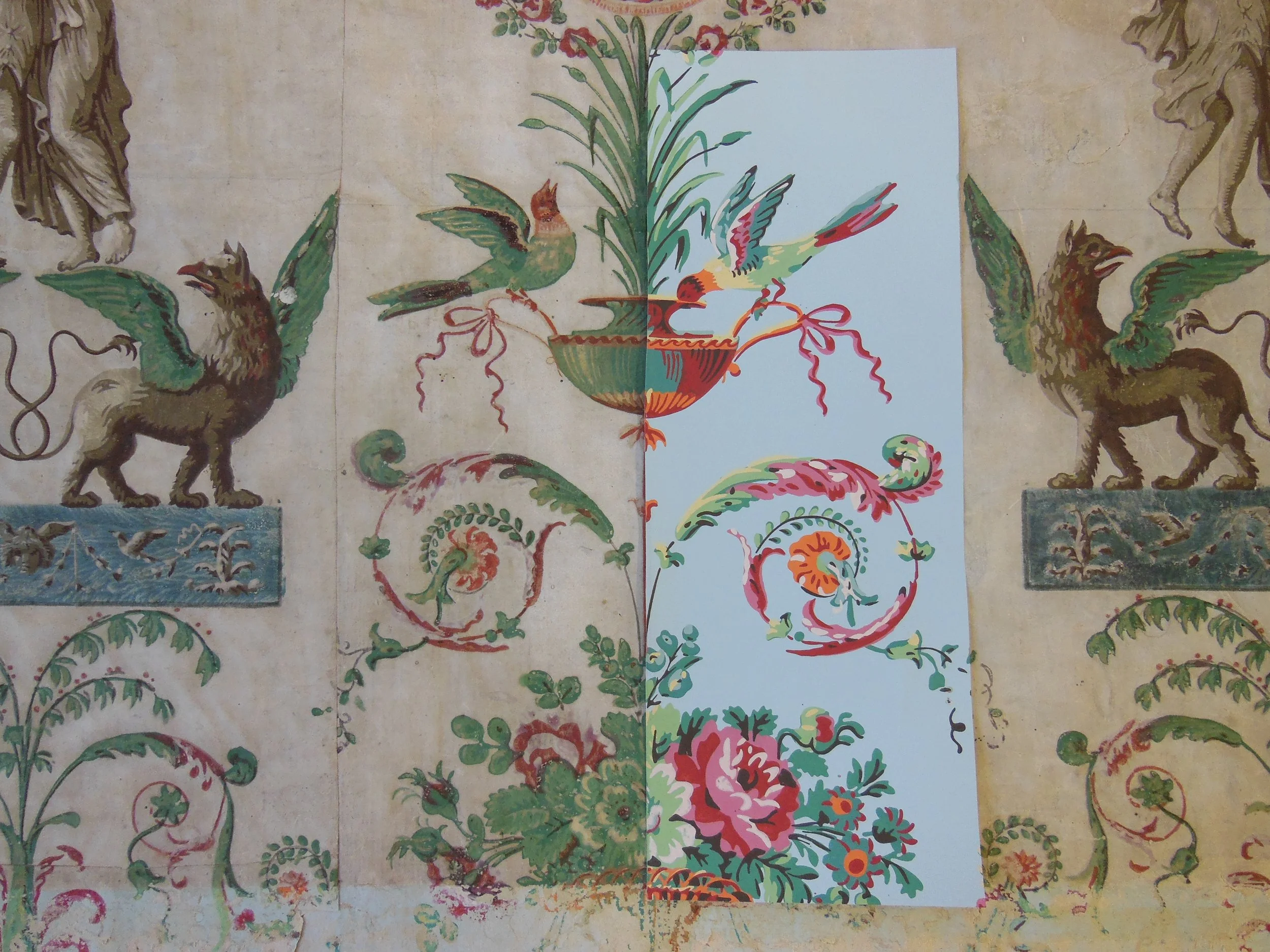
Replace with the surviving original, Adelphi reproduction, or the side-by-side museum installation.
Replace with the Monticello installation or an uncropped detail of the reproduced pattern.
“We knew that it was true.” On matching the original Soane colors
The Ambition of Réveillon
Among Adelphi’s most demanding achievements is the reproduction of the Réveillon arabesque catalogue number 600, a French design originally printed in Paris in 1787. The original rests in the Musée des Arts Décoratifs; Adelphi’s reproduction now hangs in the DAR Museum in Washington, D.C. Réveillon stood at the far end of the studio’s craft: twenty-eight blocks, fourteen colors, hand painting, and gold leaf.
The project became a feat of coordination for nearly everyone in the small shop. Michelle and Jen drafted the patterns. Dave printed the block-printed passages. Michelle and Lori handled the hand painting. Jen applied the gold leaf. Larson remembers his own contribution with dry humor: “I just sat back and worried that this was all going to fall apart. But we got it done.”
In the right light, the gold leaf catches the surface and transforms the paper from pattern into atmosphere. The human difficulty of the work is what gives it life. It involves concentration, frustration, risk, and the constant possibility of failure, but also the coordination of many hands working toward a single historic surface. In that sense, Réveillon is more than one of Adelphi’s most elaborate reproductions. It is a measure of what the studio has learned to recover.
Suggested image: a large, luminous detail of catalogue number 600.
Where the Papers Live
Occasionally the work surfaces in unexpected places. A film production company working on Martin Scorsese’s Killers of the Flower Moon once ordered sixteen rolls of Adelphi wallpaper for a set. When the movie finally premiered, the team watched closely until, for a few seconds, their paper appeared in the background of a lawyer’s office scene. Their designs have appeared elsewhere on screen as well. Adelphi’s Parakeets and Pearls wallpaper can be seen in Emma, starring Anya Taylor-Joy, another example of how production designers rely on historically accurate materials to bring period interiors to life.
Mostly, though, the papers end up in private homes, the kind of houses where the owners care about every detail being right. Most of Adelphi’s business today comes through designers, working out of showrooms in New York, Los Angeles, Chicago, Texas, London, and Australia. A homeowner can also order directly. The custom-color program means a designer can take a brightly colored historic pattern and tone it down, or take a sedate one and ramp it up tenfold. Adelphi mixes pigments to match client references and produces strike-offs for approval before printing the run.
A pattern called Carnations and Shells is Adelphi’s earliest reproduction. Its black and red lines are block printed; the rest of the colors are stenciled. Stenciling, in the period, was the less expensive alternative to wallpaper, a way of getting color on the walls if you could not afford the imported French sheets. The two practices overlapped for decades. Stenciling, Larson admits, takes time. The studio does not do it often.
Suggested image: museum, house, or film-set installation.
Suggested image: detail showing block printing and stencil work.
The People Who Do It
Everyone at Adelphi is an art school graduate. The staff is small, and many have been with the studio for decades. Michelle, Jen, and Dave have each spent much of their professional lives inside Adelphi, while Jack represents a younger generation carrying the craft forward. There is no formal apprenticeship. People find their way in, and the ones who stay tend to stay for years.
“Everyone here is an artist,” Larson says, “and has a certain temperament that makes them perfect.” By temperament, he means in part the willingness to spend a day deciding whether a quarter-inch deviation in a 1799 French repeat is a mistake worth fixing or a charm worth preserving.
When the studio drafts a pattern from an original document, the question of what is intentional and what is a printer’s slip from two hundred years ago is genuinely open. “It’s not always clear what is part of the pattern and what may have been a mistake,” Larson says. Sometimes a misaligned color is a flaw. Sometimes it is the signature of the original block cutter, the trace of a hand, and reproducing it faithfully may mean preserving the imperfection too. The judgment calls, Larson says, happen constantly. “Sometimes you have to say, I’m just letting that bother me, it’s fine. And sometimes you’re like, no, this is not good enough.” The second kind ends up as packing material.
Replace with artists printing, drafting, painting, carving, or applying gold leaf.
What the Work Requires
In a world of machine-printed wallpaper that can be affordable, washable, and available quickly, Adelphi’s papers serve a different purpose. They are made for rooms where historical preservation, hand craft, and material integrity matter. Labor-intensive, sold by the yard from large cotton-rich rolls, and made with paints valued for stability rather than scrubability, they ask to be understood as much as installed. Each roll carries the accumulated work of many decisions: paint mixed by hand, paper prepared with its ground color, blocks aligned, colors printed one impression at a time, irregularities judged, and the finished run inspected. They take time to produce and ask for careful installation by someone who understands the behavior of hand-blocked paper.
The cotton base is forgiving, though. Once pasted and allowed to sit, it relaxes and stretches more readily into place than stiffer commercial paper stock. What emerges, in return, is something difficult to obtain any other way. Stand in a room papered in Adelphi’s reproduction of a 1787 Réveillon, and the paint sits on the surface the way paint sat on a wall in Paris before the French Revolution. The colors are denser than anything a machine has printed. The gold leaf catches the light. When you put your face close to it, you can see the faint impression where a block came down and was lifted away, where someone, by hand, two hundred and thirty-eight years after the original printer did the same thing, did it again.
“I suppose the most rewarding aspect of this is simply that we’ve been able to resurrect, at least in this country, a process and art form that was largely forgotten,” Larson says, looking around the room at the long benches and the drying rolls and the basement door behind which thousands of blocks are sleeping under polyurethane in the humidified dark.
There is a roll waiting for Mount Vernon. There is a French pattern from 1799 that someone in Sharon Springs sent briefly viral on Instagram, twenty-five million views, set to Billy Idol’s Eyes Without a Face, for reasons no one at the studio can quite explain. There is a curator somewhere right now peeling a layer of overpainting off a wall in a house older than the country, and in a year or two she may mail a fragment to Sharon Springs, where someone will draw it on Mylar, by hand, and figure out what it was.
In the workshop, the next impression waits. The block is inked. The paper lies ready. The printer studies the marks, lowers the wood, and presses another fragment of history into the surface.
The trade is not lost anymore.
It is just very, very quiet.
Replace with a full-room view showing how hand-blocked paper changes the atmosphere of an interior.
Suggested image: a printer lowering the block onto a prepared length of paper.