The Bellmaker’s Voice: A Legacy Cast in Bronze
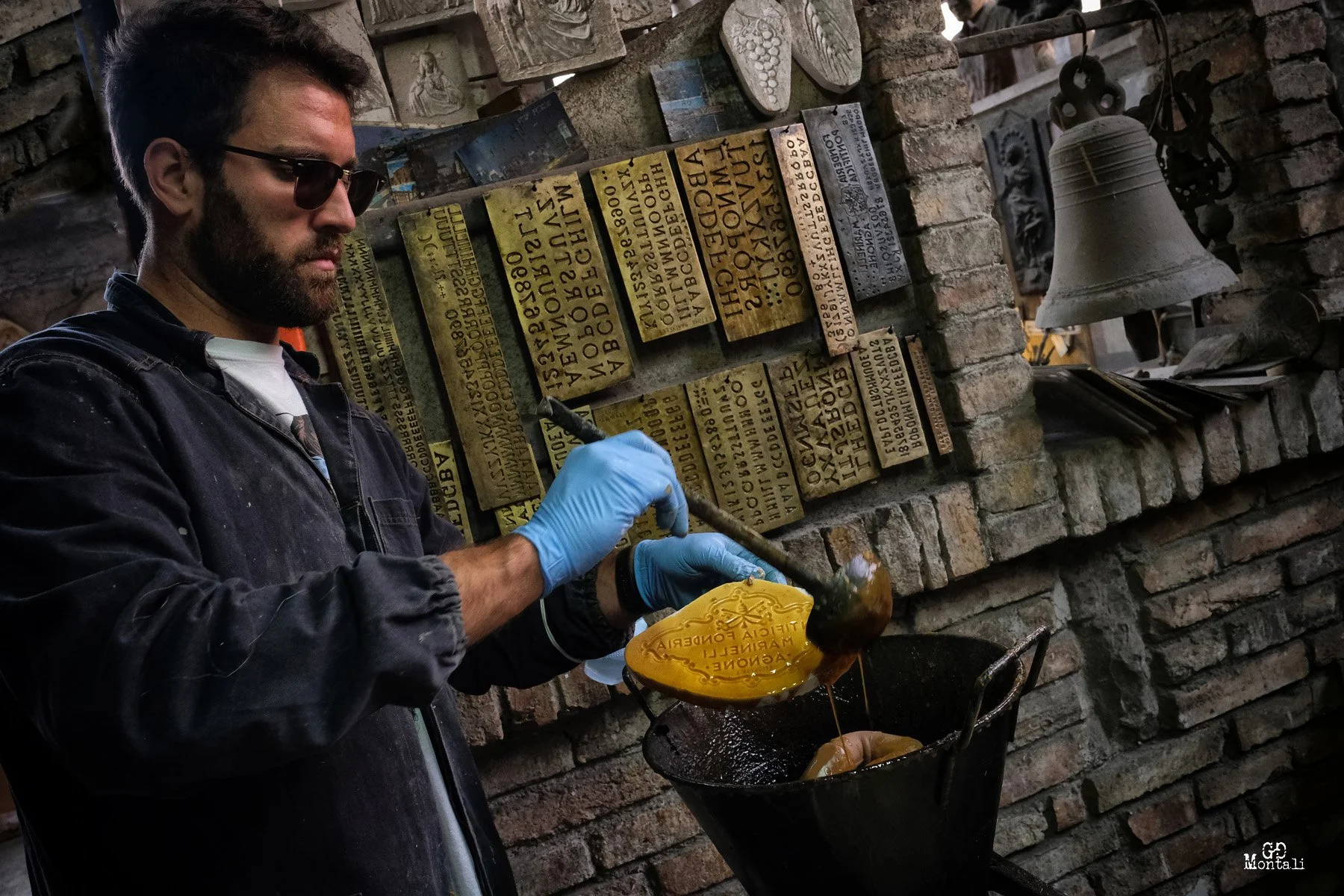
In Agnone, a remote mountain town in southern Italy, the rhythm of daily life is still measured by sound—deep, resonant, and centuries old. This is where bells are not merely cast but shaped by hand, spirit, and tradition. At the heart of it all is the Marinelli Pontifical Bell Foundry, where for nearly a thousand years, bronze has been transformed into voice.
For Armando Marinelli, its current patriarch and the 27th generation to carry the craft forward, the foundry is more than a workplace—it is memory itself. His first comes not as an image, but a scent. “It binds you since you were a child,” he says, recalling the unmistakable smell of metal, ash, and clay—a smell that still lingers in the very bones of the building.
Though he presides today over one of the world’s most enduring artisanal legacies, Marinelli did not begin as its master. In his youth, the foundry was a place to play. “We came, we played, we joked,” he recalls. But everything changed after the death of his father. Suddenly, the bells—and the weight of their meaning—became his responsibility.
At first, he considered modernizing the operation. “I wanted to turn this business around,” he says. But time and the quiet wisdom of his uncle made him reconsider. “Today, I give credit to the old generation… this job made me who I am.” He came to realize that innovation could erode the sacred. “It has a whole circle of sacredness,” he explains. “If you change it, you change everything.”
The Marinelli bells are not merely musical instruments or town markers. They are, in many cases, sacred objects. They toll for births and deaths, for prayers and warnings, for remembrance and peace. One of the most revered—the Jubilee Bell—was designed in collaboration with Pope John Paul II and now rests in the Vatican Gardens. “It gives us the most emotion every time we think of it,” Marinelli says. It’s not the only one. There are bells for Hiroshima and Sapporo, bells that crossed oceans and ideologies, some commissioned by Popes, others by parishes or civic leaders. Each leaves the foundry with a specific purpose—and a soul.
That soul is not abstract. In technical terms, it is the interior form of the bell, the shaping that determines its voice. But it is also something ineffable: the imprint of emotion, intention, and moment. “It is part of the process,” Marinelli explains, “but also the internal vibration that reaches other souls.” Every bell carries a residue of its maker’s inner life. “We hope to always feel that energy,” he adds. “Because it means the bell is alive.”
Some bells resonate more deeply than others. Marinelli recalls one in particular—a thousand-kilo bell tuned to E-flat—that left a permanent mark on him. “It has something more… a deep answer inside you.”
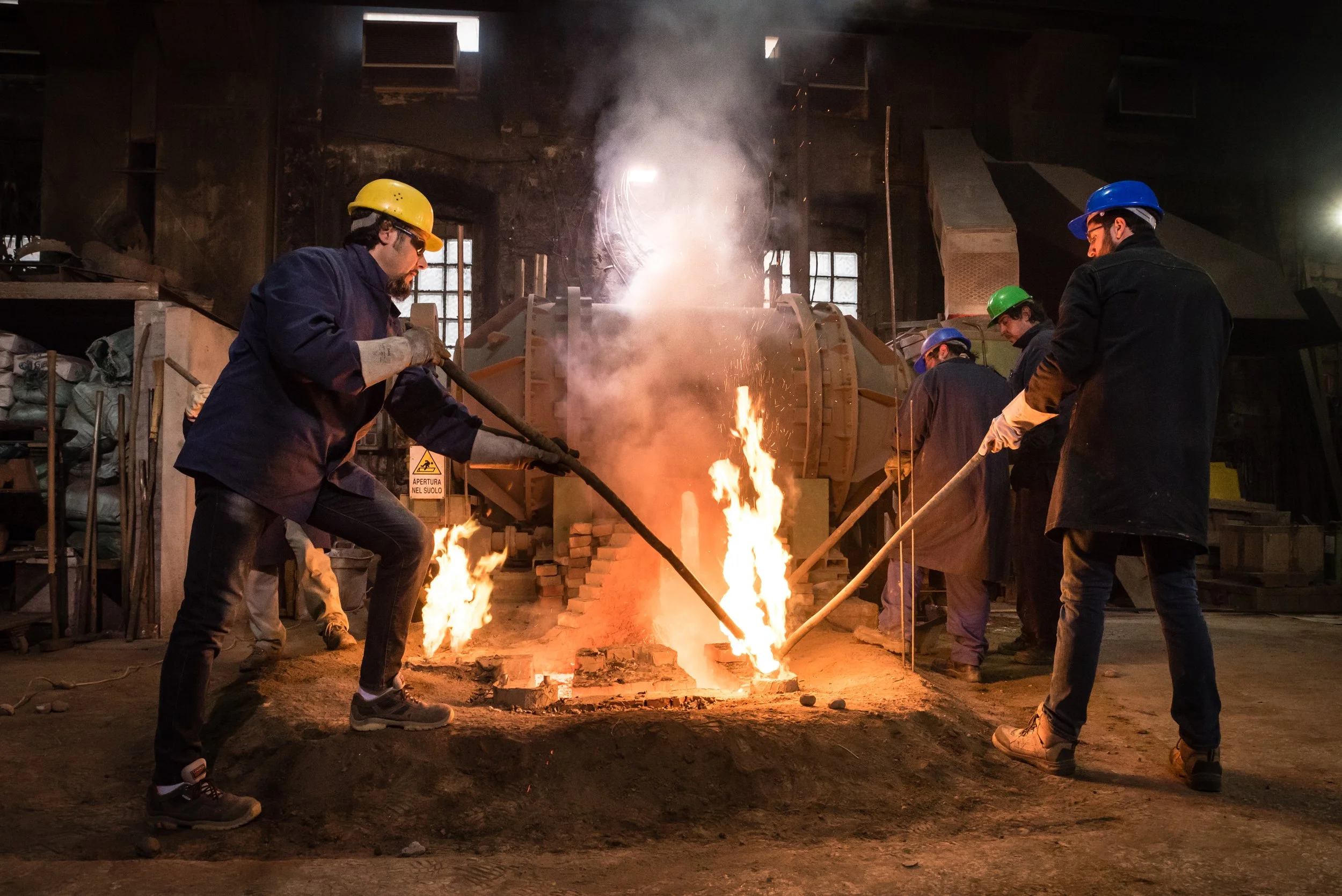
Despite centuries of tradition, the foundry does not run on manuals or formulas. Much of the work remains intuitive and tactile. “Looking at the fusion, at the temperature of the oven—just by color—you know when it’s right,” he says. “You cannot write that down.” Working the clay, knowing when it’s ready for a new layer, requires touch more than sight. “It’s like a recipe for a dessert,” he adds. “You may have the ingredients, but not know how to mix them.”
Long ago, these were closely guarded secrets, often not even passed to one's own children. Today, while more steps are documented, mastery still comes only through experience. “You understand some phases of the work only with your eyes,” he says. Or your hands. Or your soul.
Each bell carries intention. Marinelli notes that even a single bell—just one note—can speak many languages depending on how it is played. “It can announce Mass, signal mourning, or celebrate a birth,” he says. “The same bell can communicate different meanings depending on the rhythm and the swinging.” Some tones are solemn, others jubilant. In certain villages, bells still ring for the birth of a child.
Yet the meaning is never arbitrary. “It changes the rhythm of the day,” he explains. Bells ring for the Angelus at morning, noon, and evening; for funerals with slow, deep peals; and for weddings with a quickened tempo. When multiple bells ring together, their layered notes create even more nuanced conversations with the town below.
Though traditionally Catholic, bells have found their way into other traditions as well. Marinelli acknowledges their presence in Orthodox churches, though not in Islam. Still, they transcend their origin. He recounts how a bell gifted to Sapporo, Japan, initially caused concern due to its Vatican symbolism. “They didn’t want to accept it,” he recalls. Only after explaining that the coat of arms belonged to the foundry—not the Church—did the community embrace it.
Marinelli’s favorite story of a bell’s reception is not one of jubilation but of critique. After a 700-year-old bell was recast and returned to its tower, a woman in the church stood and said, “This bell is not the same as the one before.” Her dismay was met with an honest—and poetic—response: “To have the same sound of a bell that rings for 700 years, you have to wait 700 years.”
There is a sacred moment when the bronze meets the mold—a point Marinelli describes as transformative. “The bronze, already blessed, enters the form. An inanimate ingot becomes animate. It becomes a voice.” In that moment, centuries of labor, faith, and craftsmanship converge.
Asked if he could choose just one bell to represent his family's legacy, Marinelli hesitates. Every bell matters. But finally, he names the “bell of the millennium,” the oldest in the foundry’s possession, passed down like a relic. “It is a symbol of our activity. A lucky charm.”
Not all bells are meant to ring. The most unusual commission Marinelli ever received was for a bell that would remain forever silent—shaped like a bell, cast like a bell, but destined to stand fixed, a monument in bronze. “It has all the characteristics… except for the sound.”
Decorative elements are determined in part by the client, in part by the hand of the artist at the time. But aesthetics, too, are secondary to the music. “Sometimes we have to use less decoration for the sound,” he explains. “It affects the tone—a lot.”
Some bells live only in memory, but others are visited like old friends. When traveling, Marinelli often hears bells and quietly checks the foundry’s stamp. “Sometimes we say, ‘There’s my bell,’” he says, with quiet pride. In Agnone, even strangers refer to the foundry as if it were their own. “People say, ‘Ah, the town where bells are built.’”
During World War II, bells were seized and melted into weapons. After the war, those cannons were recast into bells. It’s a poetic inversion not lost on Marinelli: “Peace objects became war objects… and then back again.”
He is clear on what would be lost if the bells of Agnone fell silent. “It would mean there is no more religion,” he says simply.
And yet, the foundry endures. It survives not through contracts or commerce, but through transmission—of knowledge, of devotion, of passion. “We inherited this work,” he says. “We transmit it hand in hand.” His children and grandchildren are already preparing to take over. “They have to transmit the disease,” he says, with a grin. “In the meaning of passion. Passion is a disease.”
And so, in Agnone, the bells still ring. Their voices rise not just to call communities to worship, but to echo across centuries—bearing the unmistakable sound of something forged by hand, carried by soul, and cast in faith.